
From Laboratory Breakthroughs to Industrial Reality: Swiss startup Chiral
February 13, 2026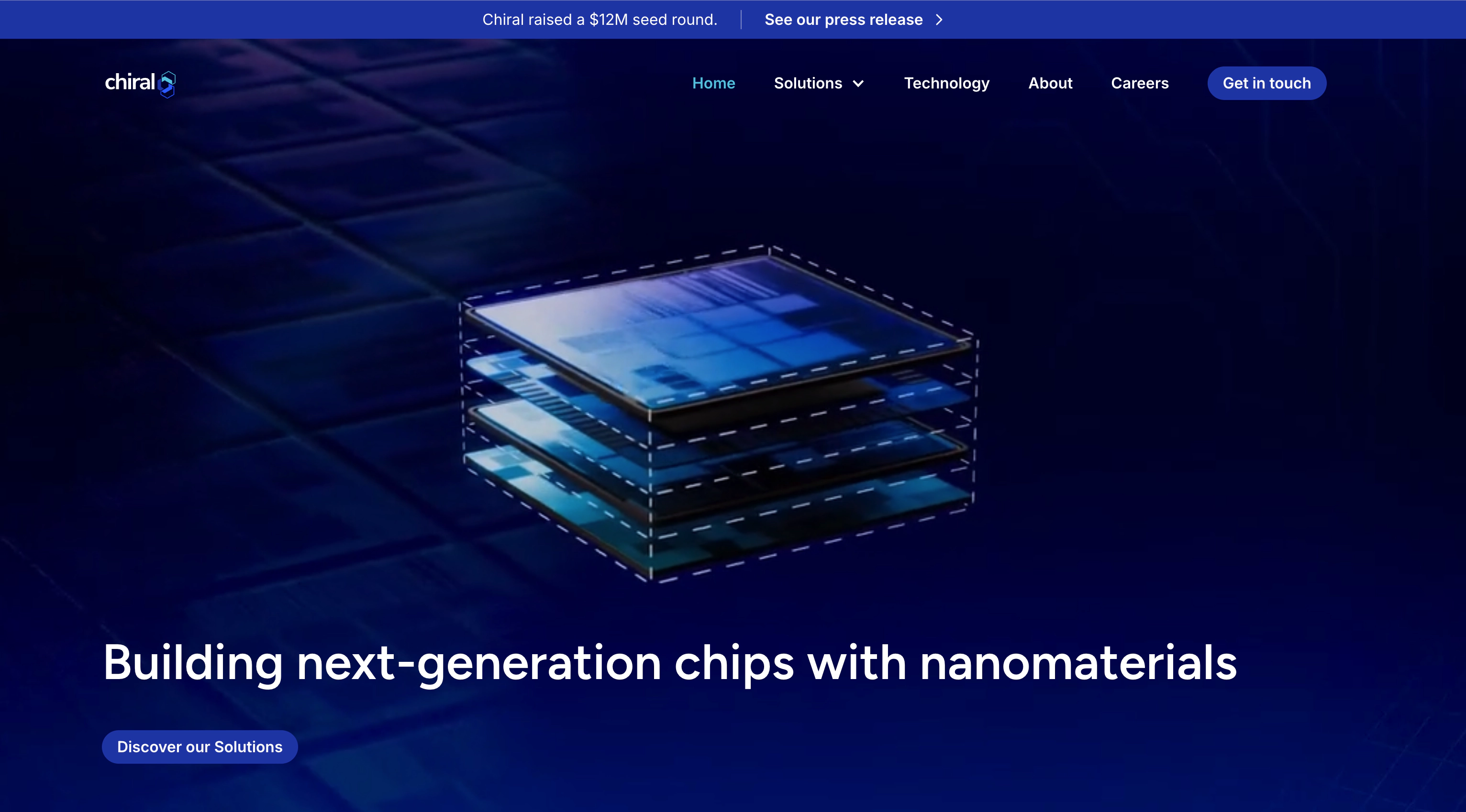


As Europe’s DeepTech sector continues to keep growing, a Swiss nanotechnology startup Chiral has recently secured a €10 million Seed round. Such funding shows a broader shift in how innovation is being funded and developed. In this article, we’re going to tell you what’s special about this startup and why it’s important.
Chiral has been backed by Crane Venture Partners, Quantonation, HCVC, Founderful, and public innovation support from Innosuisse. The company is trying to figure out how to move breakthrough materials from research environments into real manufacturing. This issue with semiconductors has lasted for years. And finally, there’s someone to cope with it.
Nanomaterials such as carbon nanotubes and two-dimensional materials have repeatedly demonstrated exceptional performance in laboratories. Yet adoption has remained limited because large-scale, precise, and contamination-free integration into chips is extremely difficult. What Chiral did was create an automated robotic system. The system itself combined precision engineering, automation, and AI-controlled processes. This mix of technologies allowed to integrate nanomaterials directly into silicon wafers.
And it doesn’t end in one company only. We all know that there are physical and economic limits of traditional silicon scaling nowadays. Moreover, new computing architectures and materials are becoming necessary to sustain performance and energy efficiency improvements. For example, if we look at the statistics, we can see that in the recent 2 years, Europe has seen growing investment across photonic computing, programmable optical systems, and advanced semiconductor infrastructure. What we see clearly here is that future computing progress will depend not only on scientific breakthroughs. It depends on the ability to manufacture them reliably.
Why Early-Stage Support Determines Outcomes
When we look at the path of DeepTech startups, we can see that the way they choose to go is completely different. Moreover, it even differs from typical tech companies. Let’s take a look at their development cycle: it’s longer, and tech risks are higher. There’s also a need for both capital and specialized guidance. The period between successful research and market deployment is often the most vulnerable stage. This stage is difficult because the business infrastructure around it is still forming.
If we talk about Chiral, we can see that it has already developed its first commercial equipment and begun installations with customers. Their step into the deployment shows that they’re different. It’s the exact moment where many promising ventures struggle to advance without coordinated support from investors and strategic partners.
At Impulse Generator Fund, we keep an eye on projects and startups like this one. It shows the ecosystem gap startups face. We’re here to provide early capital, mentorship, and investor networks to help founders and investors. Let’s convert scientific potential into sustainable businesses.

View more articles
Browse our collection of articles below and embark on a journey of discovery.